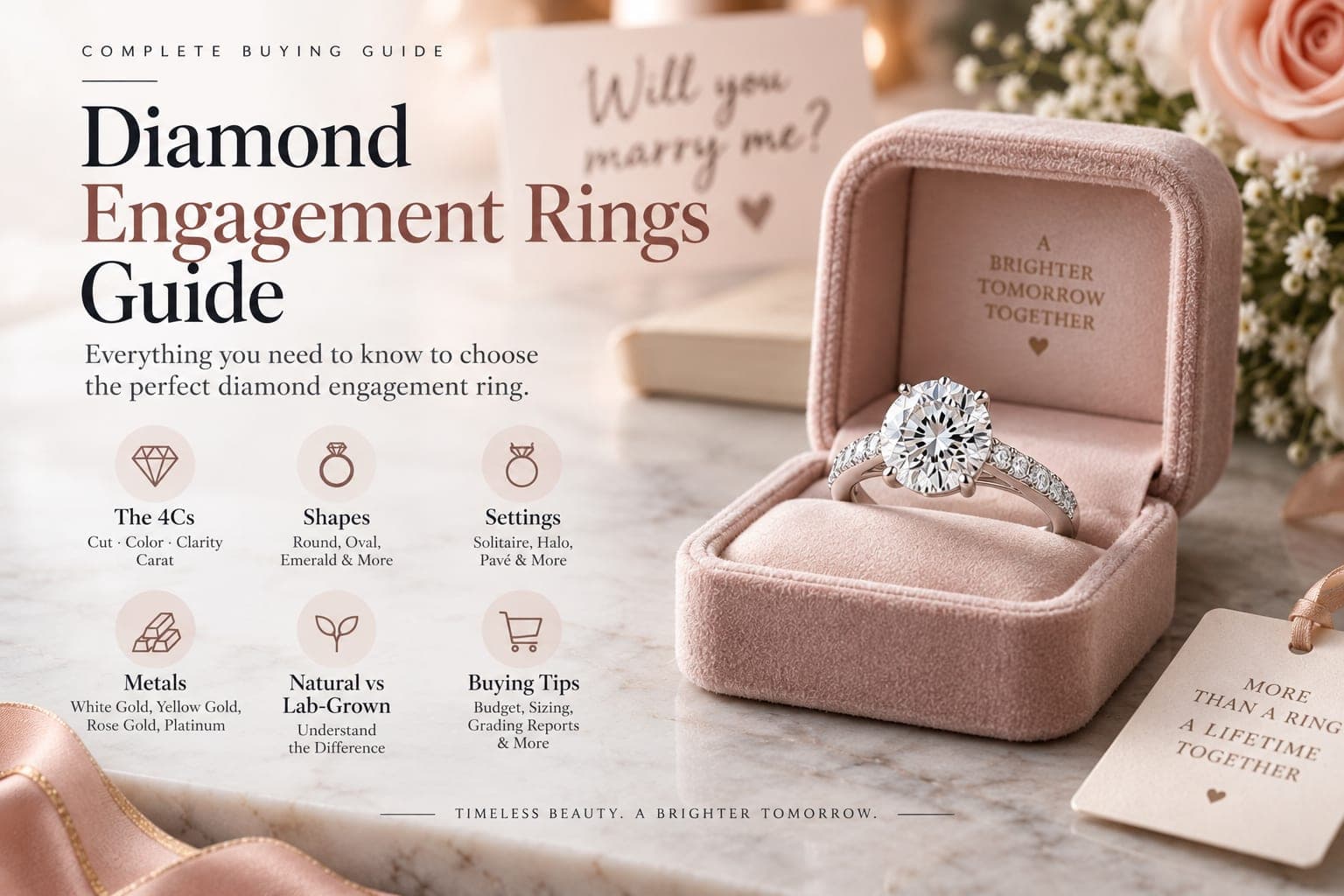
A diamond engagement ring combines several decisions into one piece of jewelry. You need to consider the diamond itself, its shape, setting, metal, ring size and overall design.
The diamond is usually the centerpiece, but choosing one isn't simply a matter of finding the largest stone you can afford. The 4Cs—cut, color, clarity and carat weight—provide a standardized way to understand diamond quality, while the shape and setting influence how the finished ring looks.
Whether you're beginning your search or comparing specific rings, understanding these elements can make the process much easier.
What Is a Diamond Engagement Ring?
A diamond engagement ring is a ring featuring one or more diamonds as its primary gemstone.
The classic design usually has a center diamond mounted in a metal setting, although engagement rings can also feature side stones, halos, multiple center stones and other arrangements.
The same diamond can look completely different depending on its:
Shape
Cut quality
Setting
Metal
Proportions
Surrounding stones
That's why it's useful to evaluate the diamond and the ring design separately before making a decision.
Understanding the 4Cs of Diamond Quality
The first thing to learn when shopping for diamond engagement rings is the 4Cs.
They are:
Cut
Color
Clarity
Carat weight
GIA developed the 4Cs as a standardized system for evaluating diamond quality.
1. Diamond Cut
Cut describes how well a diamond's facets interact with light.
It is different from diamond shape.
A diamond can have a round, oval or other outline while also having a particular faceting pattern.
For round brilliant diamonds, GIA provides an official cut grade ranging from Excellent to Poor. Cut quality influences brilliance, fire and scintillation.
This is one reason two diamonds with similar carat weights can look noticeably different.
Why cut matters
A well-cut diamond can produce strong light performance, while a poorly proportioned stone may appear less lively even when it has a high carat weight.
If sparkle is important to you, don't evaluate a diamond based on carat weight alone.
2. Diamond Color
Diamond color refers to the degree of color visible in a white diamond.
GIA's D-to-Z scale begins with D, representing the highest colorless category, and progresses toward diamonds with more noticeable yellow or brown color.
Color preferences can also depend on the shape and metal of the ring.
For example, some step-cut diamonds can reveal body color more readily because of their larger, open facets.
The goal isn't necessarily to choose the highest possible color grade. Instead, consider how the diamond looks in the actual setting and how its color works with the ring metal.
3. Diamond Clarity
Clarity refers to internal characteristics called inclusions and surface characteristics called blemishes.
The clarity scale ranges from diamonds with no visible inclusions or blemishes under specific grading conditions to diamonds with characteristics that are more apparent.
The important point for shoppers is that clarity should be considered alongside the diamond's actual appearance.
Two diamonds with the same clarity grade may not look identical.
This is particularly relevant with certain shapes. Step-cut diamonds such as emerald and Asscher can make inclusions easier to see because of their larger facets.
4. Diamond Carat Weight
Carat is a measurement of weight, not visual size.
One carat equals 0.2 grams, and a carat is divided into 100 points.
A higher carat weight generally means a larger and rarer diamond when other characteristics are comparable, but carat weight doesn't tell you everything about how large the diamond will appear from above.
Shape and proportions also influence face-up appearance.
For example, elongated shapes such as oval and marquise can create a larger-looking outline relative to their weight.
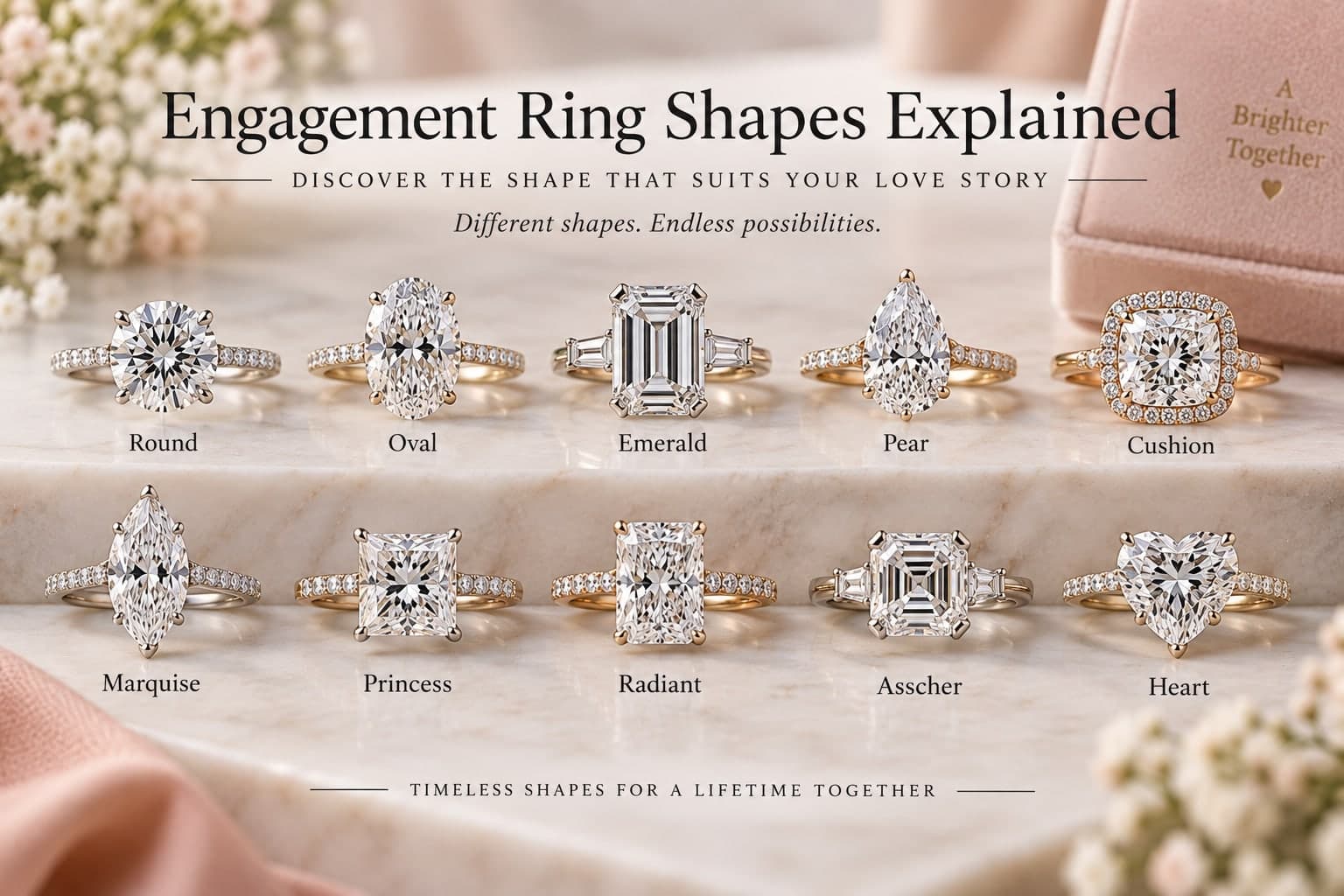
Diamond Shape vs Diamond Cut
This is one of the most common sources of confusion when shopping.
Shape refers to the diamond's geometric outline.
Cut refers to how the facets are arranged and how the diamond interacts with light.
For example:
Round is a shape.
Oval is a shape.
Pear is a shape.
Brilliant is a cut style.
Step cut is a cut style.
Some terms, such as emerald cut and princess cut, are commonly used to describe both a particular outline and its associated faceting style.
For a deeper explanation, see our guide to engagement ring shapes.
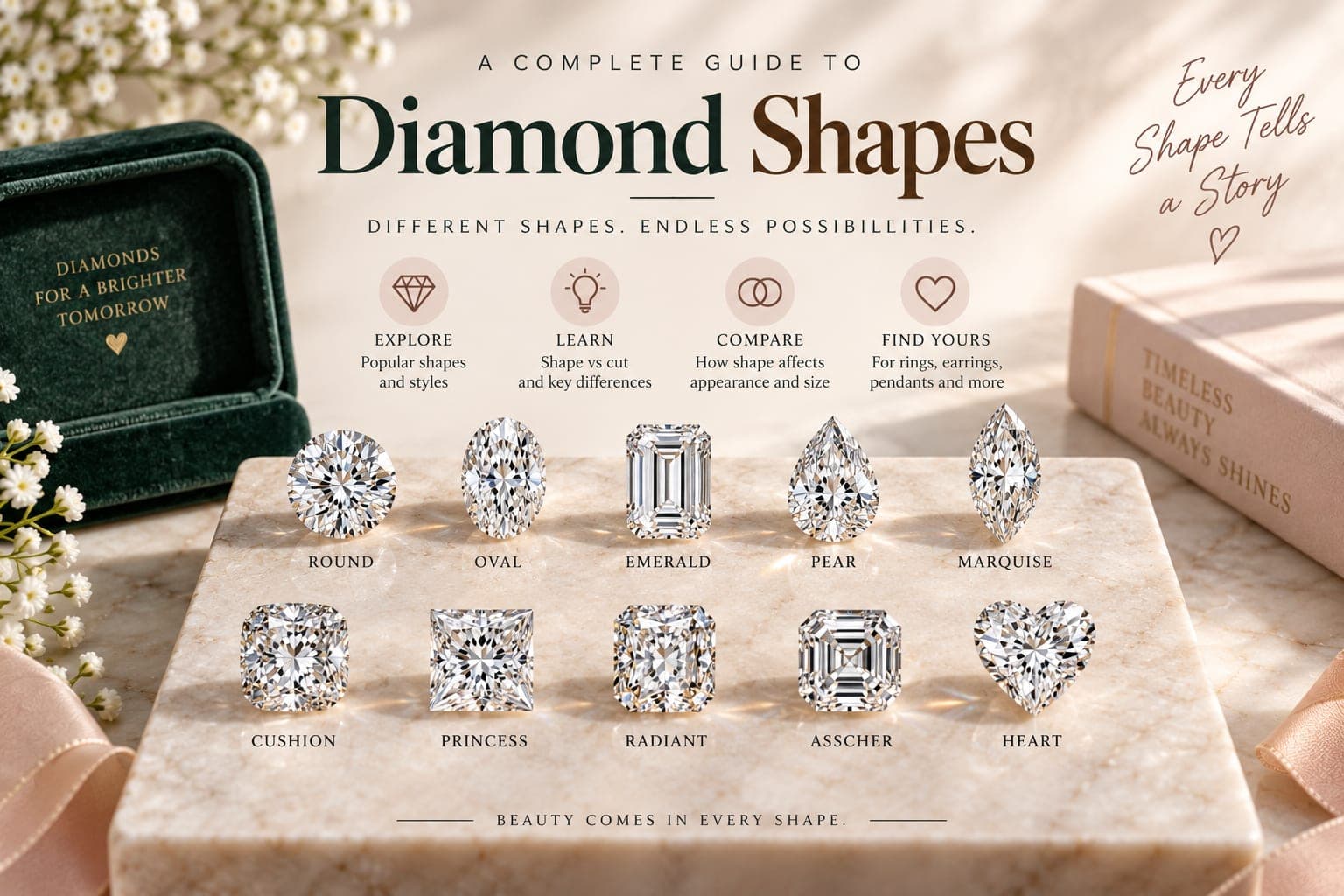
Popular Diamond Shapes for Engagement Rings
There are many diamond shapes to consider.
Round Brilliant
Round brilliant diamonds are a classic choice and are known for their strong brilliance.
GIA describes the round brilliant as the most popular and iconic diamond shape and notes that it is the only shape with an official GIA cut grade.
Oval
Oval diamonds have an elongated outline and brilliant-style faceting.
They can provide a different silhouette from a round diamond while retaining substantial sparkle.
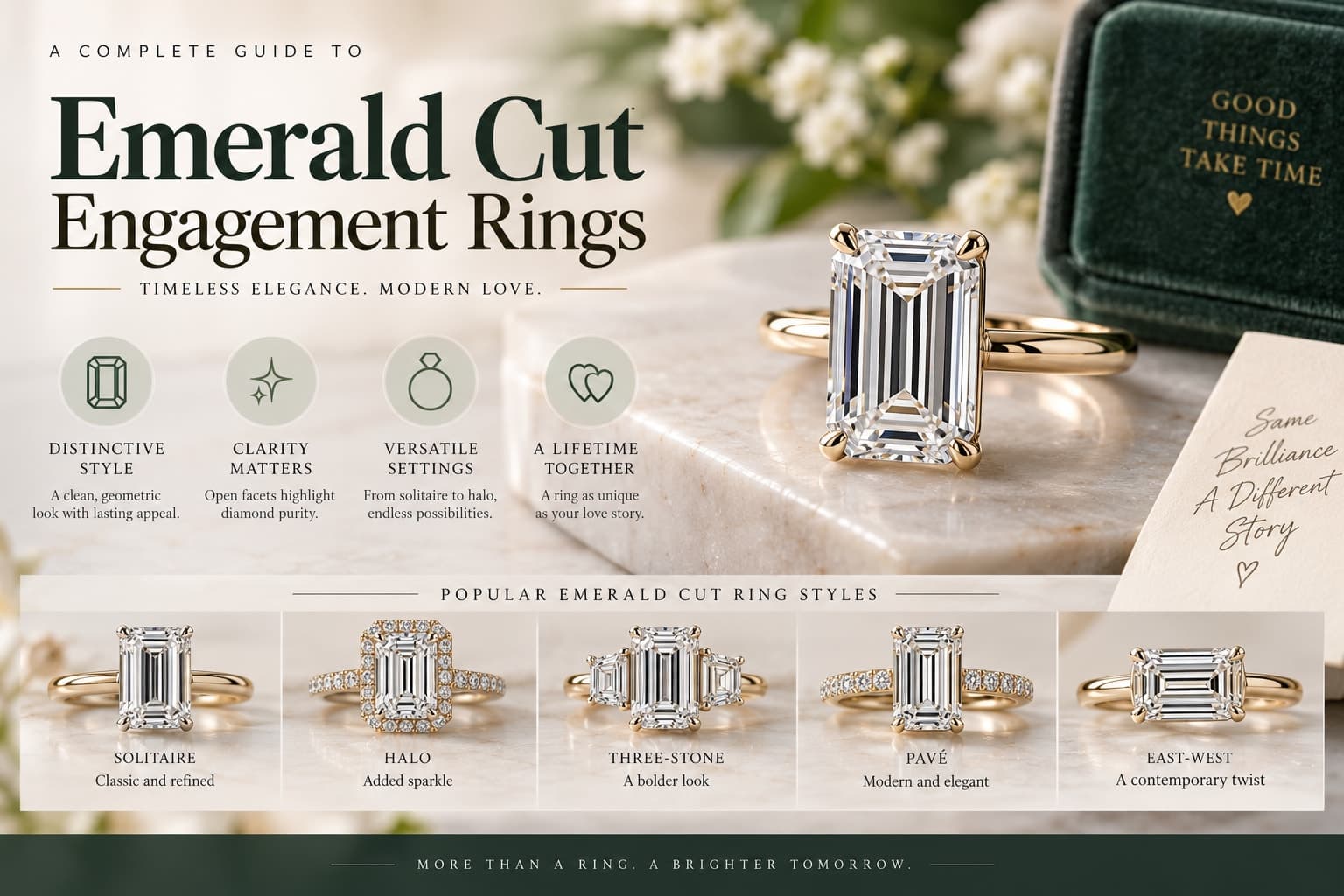
Emerald
Emerald-cut diamonds have a rectangular outline with cropped corners and step-cut facets.
Their larger facets produce a more reflective appearance and can make clarity and color more noticeable.
Read our dedicated emerald cut engagement rings guide for a deeper look at this style.
Pear
Pear diamonds combine a rounded end with a pointed tip.
The point requires particular attention when selecting the setting because it can be more exposed to impact.
Cushion
Cushion diamonds generally have square or rectangular outlines with rounded corners.
They can have different faceting patterns, so two cushion diamonds can have noticeably different appearances.
Marquise
Marquise diamonds are elongated with pointed ends.
Their distinctive outline can give an engagement ring a dramatic appearance.
Princess
Princess diamonds are generally square or rectangular with sharp corners and brilliant-style faceting.
Protecting the corners is an important setting consideration.
Radiant
Radiant diamonds combine a rectangular or square outline with brilliant-style faceting.
Their cropped corners can provide a balance between geometric structure and strong sparkle.
Choosing the Right Diamond Engagement Ring Setting
The setting determines how the diamond is mounted and presented.
Common options include:
Prong
Solitaire
Halo
Bezel
Pavé
Cathedral
Three-stone
Channel
Cluster
Tiffany describes a setting as the way gemstones are mounted into a metal band, while style refers more broadly to the overall design aesthetic.
This distinction is important for your ring search.
A ring can have a classic style, a round diamond shape, and a prong setting, for example.
For a complete explanation, see our engagement ring settings guide.
Natural vs Laboratory-Grown Diamonds
One of the decisions facing modern diamond shoppers is whether to choose a natural diamond or a laboratory-grown diamond.
Natural diamonds form naturally within the Earth.
Laboratory-grown diamonds are produced through technological processes and have essentially the same optical, physical and chemical properties as mined diamonds, according to GIA's laboratory-grown diamond information. GIA's laboratory-grown reports identify the stones as laboratory-grown.
The important thing is to know exactly what you're purchasing.
The FTC advises that laboratory-grown diamonds should be clearly identified as such rather than presented in a way that could make consumers believe they are buying mined diamonds.
Questions to ask
When comparing a natural and laboratory-grown diamond, check:
How the diamond is identified
What grading or quality documentation accompanies it
The 4Cs information
The retailer's return policy
The total price
The ring's metal and setting
Any warranties or service policies
Don't rely solely on photographs or a product title.
Why a Diamond Grading Report Matters
A grading report provides independent information about a diamond's characteristics.
GIA recommends asking for a grading report and using it to understand the diamond's identity and quality.
When purchasing a diamond, compare the information on the report with the actual stone and the seller's description.
For online purchases, GIA recommends looking for diamonds accompanied by reports from reputable laboratories and suggests examining available 360-degree views where possible.
A report doesn't replace seeing the diamond, but it gives you useful standardized information for comparison.
How Much Should You Spend on a Diamond Engagement Ring?
There is no universal amount that every person should spend.
Instead, establish a budget that works for your own financial situation before comparing diamonds.
GIA specifically recommends considering your budget at the beginning of the buying process and asking a jeweler to show you diamonds within your range.
Once you have a budget, you can decide which characteristics matter most.
For example, someone might prioritize:
Diamond size
Cut quality
A particular shape
Higher clarity
Higher color
A specific metal
A more elaborate setting
There is no requirement to maximize every characteristic.
The 4Cs give you a framework for deciding where your budget goes.
How to Get More From Your Diamond Budget
If you're comparing diamonds within a fixed budget, don't look only at carat weight.
Consider the complete combination of:
Cut + Shape + Color + Clarity + Carat + Setting
GIA notes that fancy shapes can sometimes provide an alternative to round brilliant diamonds and may offer different pricing characteristics.
You can also compare different settings.
A simple solitaire, for example, puts more visual emphasis on the center diamond, while a halo or diamond-accented design adds additional stones.
The important thing is to compare complete rings rather than judging one specification in isolation.
Choosing the Metal for a Diamond Engagement Ring
Common engagement ring metals include:
Yellow gold
White gold
Rose gold
Platinum
The metal affects the ring's appearance and can also influence maintenance requirements and overall price.
Think about the jewelry the wearer already owns.
If they normally wear yellow gold, for example, a yellow-gold engagement ring may fit naturally into their existing collection.
If their jewelry is mostly white metals, platinum or white gold may create a more consistent appearance.
The decision is ultimately about the combination of appearance, practicality and preference.
Think About Ring Size
An engagement ring needs to fit comfortably.
If you're planning a surprise proposal, finding the correct size can be challenging.
Possible sources of information may include:
An existing ring they wear
A trusted friend or family member
A jeweler who can help estimate sizing
Rings they already own
Avoid guessing based only on height or body size.
If the size isn't perfect, ask the jeweler about resizing before purchasing.
How to Choose a Diamond Engagement Ring Step by Step
Here's a practical process to follow.
Step 1: Set Your Budget
Determine what you're comfortable spending before browsing.
Step 2: Learn the 4Cs
Understand cut, color, clarity and carat weight.
Step 3: Choose a Shape
Consider round, oval, emerald, pear, cushion, marquise, princess, radiant or another shape.
Step 4: Choose a Setting
Decide whether you prefer a solitaire, halo, bezel, three-stone or another design.
Step 5: Select the Metal
Compare platinum, yellow gold, white gold and rose gold.
Step 6: Check the Ring Size
Get the best measurement possible before ordering.
Step 7: Check the Diamond Documentation
Look for an appropriate grading or quality report.
Step 8: Compare the Complete Ring
Compare the diamond, setting, metal, craftsmanship, price, warranty and return policy together.
Step 9: Inspect the Diamond
If buying online, look for detailed photographs, videos or 360-degree views where available. GIA recommends examining diamonds under different lighting conditions when possible.
Step 10: Review the Seller
Look at the retailer's policies and reputation before completing the purchase.
Buying a Diamond Engagement Ring Online
Online shopping gives you access to a large selection of diamonds and rings, but it requires careful comparison.
Before purchasing, check whether the listing provides:
Diamond shape
Carat weight
Color grade
Clarity grade
Cut information where applicable
Grading report
Metal type
Ring size options
Return policy
Warranty or service information
Clear photographs or videos
GIA specifically recommends buying online from retailers that provide reputable laboratory reports and notes that 360-degree views can help shoppers evaluate individual diamonds.
Also remember that two diamonds with identical report information can still appear different in person.
Questions to Ask a Jeweler
Before buying a diamond engagement ring, consider asking:
What laboratory graded the diamond?
Can I see the grading report?
What are the diamond's 4Cs?
Is the diamond natural or laboratory-grown?
What is the diamond's shape and cut style?
What setting is being used?
What metal is the ring made from?
Can the ring be resized?
What is the return period?
Is there a warranty?
What maintenance does the ring require?
Are there any treatments or other characteristics I should know about?
These questions can help you compare rings using more than appearance and price.
Diamond Engagement Ring Checklist
Before purchasing, use this quick checklist:
☐ Set a realistic budget
☐ Understand the 4Cs
☐ Choose a diamond shape
☐ Decide between natural and laboratory-grown
☐ Check the grading documentation
☐ Choose the setting
☐ Select the metal
☐ Confirm ring size
☐ Compare return and warranty policies
☐ Inspect the actual diamond or detailed imagery
☐ Compare complete rings rather than one specification
☐ Keep the receipt and documentation
Frequently Asked Questions
What are the 4Cs of a diamond?
The 4Cs are cut, color, clarity and carat weight. They provide a standardized framework for evaluating diamond quality.
What is the most popular diamond shape for engagement rings?
Round brilliant is the most popular diamond shape according to GIA's current diamond-shape guide.
Is carat the same as diamond size?
No. Carat measures weight, not the diamond's visible dimensions. Shape and proportions influence how large a diamond appears from above.
Should I buy a natural or laboratory-grown diamond?
Both are options worth researching. The important thing is to understand the diamond's origin, documentation, characteristics and price before purchasing. Laboratory-grown diamonds should be clearly identified as laboratory-grown rather than presented as mined diamonds.
What should I check before buying a diamond engagement ring?
Check the diamond's 4Cs, shape, grading documentation, setting, metal, ring size, seller policies, warranty and return conditions.
Is the most expensive diamond always the best choice?
Price alone doesn't tell you whether a diamond is the right choice. Compare the characteristics that matter to you within your budget and evaluate the complete ring.
Final Thoughts
Choosing a diamond engagement ring becomes much easier once you separate the decision into individual parts.
Start with your budget, learn the 4Cs, choose a diamond shape, compare settings and metals, and verify the diamond's documentation before purchasing.
Most importantly, don't judge a ring by carat weight alone. The combination of diamond quality, shape, setting and design determines how the finished ring looks and feels.
A well-researched purchase gives you something more valuable than a large specification sheet: confidence that the ring you choose matches your preferences, budget and the person who will wear it.